Written by PJ, from VELD FIRST, KAROO DIREK, DIE VEEPOS and KAROO-KALAHARI VEEVOER & LOGISTIEK
Also referred to as a ‘fire load’, burnload is the total volume of combustible material and potential heat energy in a given space.
Fire safety and engineering
Definition: burnload measures all the materials that can catch fire such as wood, paper, furniture, and plastics, within a room, in a building or on a piece of land.
Measurement: burnload is usually calculated in megajoules per square meter (MJ/m²) by multiplying the mass of the items by their calorific value, divided by the floor or terrain area. For example, the calorific value of a mature pine tree is ~19.5 to 21.0MJ/kg, with an average weight of a tree being 2000kgs. 2000kgs x 20MJ/kg =40 000MJ. Let’s say the plantation is 10 hectares (100 000 m²) with 10 000 trees planted. So 400 000 000MJ/ 100 000 m² = 4000MJ/m² – this would be an extremely high and dangerous burnload to carry. Even half this mass is considered hazardous.
Purpose: firefighters, engineers and fire safety managers use this number to calculate how hot a fire could burn, and to design proper safety systems and mitigation
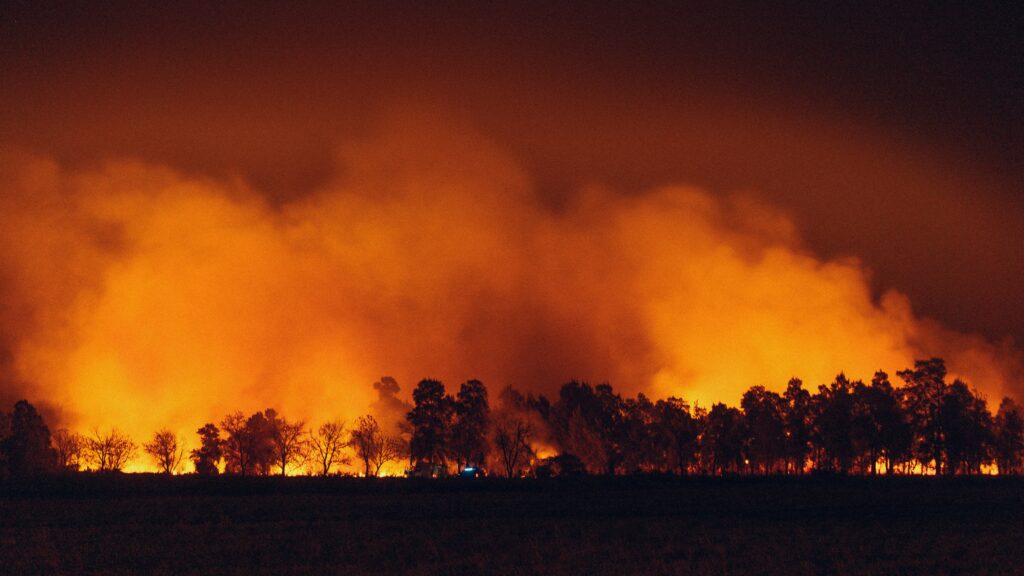
Photo by Fachy Marín on Unsplash
Why is burnload assessment important for farmers?
In agriculture, burnload (or fuel load) assessment is the process of measuring the total volume, height, and dryness of combustible organic matter, including dry grass, crop residue, and invasive brush, on a piece of land. Conducting a burnload assessment is a
vital risk-management practice for farmers for several key reasons:
1. Wildfire prevention and suppression
High fuel loads dramatically increase the intensity and spread rate of accidental veld or brush fires. By assessing the burnload, farmers can:
- Design effective firebreaks: determine how wide a firebreak needs to be to stop a fire from jumping boundaries. Often a minimum of 15 metres is required, but should be wider still if the fuel load is high or if the gradient of a slope is steep.
- Protect infrastructure: identify areas near homesteads, barns, or silage storage that require immediate protection, grazing or mechanical clearing to minimize the fire threat from radiant heat or sparks.
2. Planning safe prescribed burns
Controlled burning is a common farm management tool used to clear dead vegetation,
control pests, and rejuvenate pastures. An accurate burnload assessment helps farmers
execute this accurately and safely:
- Predicting fire behaviour: knowing the fuel volume allows farmers to determine if a fire will be a manageable ‘cool fire’ (patchy burn, low flames) or a dangerous ‘hot fire’ with intense flames that can destroy the soil profile and damage tree canopies.
- Weather compliance: this dictates the precise weather windows, including wind speed, and humidity, required to burn safely without losing control
3. Pasture and Grazing Management
For livestock and game farmers, assessing dry biomass is essential for balancing ecosystems:
- Forage quality: it helps separate nutritious, palatable grass from old, woody, moribund vegetation that needs to be cleared to stimulate new seasonal growth.
- Rotational grazing: farmers use fuel assessments to determine where to herd livestock to naturally lower the burnload through intensive grazing.
4. Soil and economic protection
While burning can clear veld and fields quickly, an assessment helps farmers weigh the pros and cons:
- Nutrient conservation: excessively heavy burning destroys critical soil microbes, earthworms, and vital nutrients like nitrogen and sulphur. Evaluating the burnload allows farmers to decide if they should instead till the residue back into the ground to
protect soil health, or consider other manual interventions.
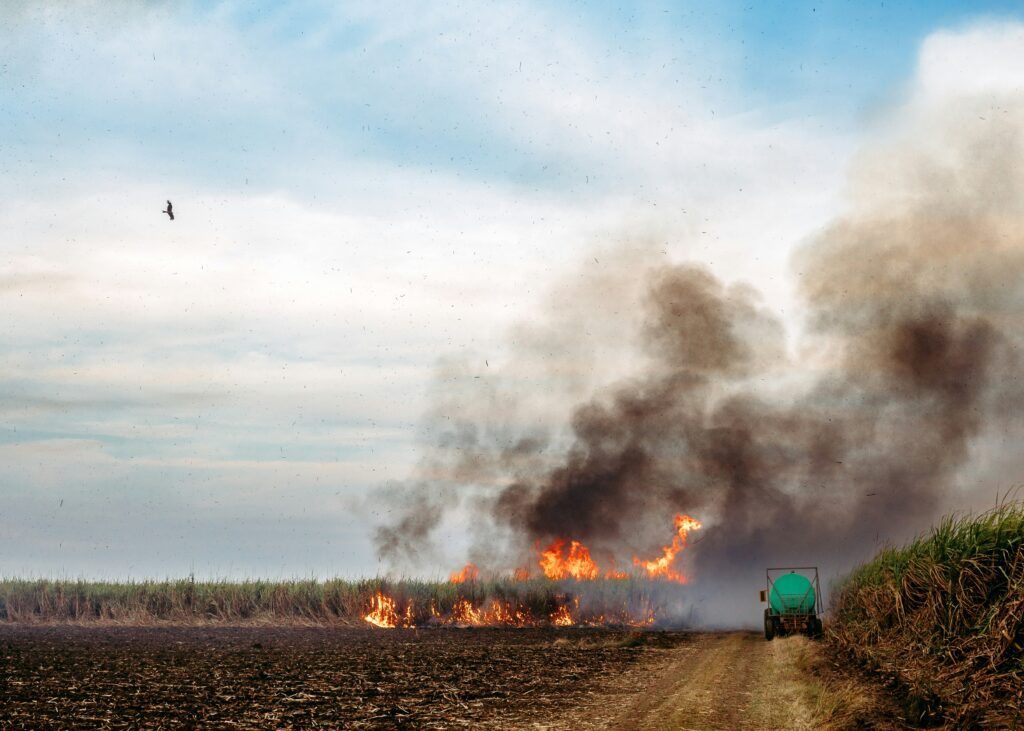
Photo by Sandie Peters on Unsplash
How can a farmer reduce the burnload on his farm?
To effectively reduce the burnload (fuel load) on a farm, a farmer must proactively manage both live and dead plant matter. Lowering the burnload is the single most controllable way to reduce a fire’s intensity, making it easier to suppress if an accidental breakout occurs.
Farmers can achieve this, using biological, mechanical, and strategic chemical (prescribed) methods:
1. Livestock and biological management
Using animals is one of the most cost-effective and ecologically sound ways to keep fuel loads down.
- High-density, rotational grazing: concentrating livestock in a specific camp for short periods forces them to eat and trample down heavy grass and dead, old vegetation that would otherwise become dry fuel.
- Patch-burn grazing: burning only a small fraction (e.g., one-third) of a pasture attracts livestock to the highly nutritious fresh growth. They will graze it down intensely, creating natural, low-fuel zones that break up continuous stands of combustible
material across the farm. - Browsing with goats: for woody brush or invasive bush encroachment, introducing small ruminants like goats helps strip the leaves and bark, drying out and killing off the woody biomass that contributes to hot canopy fires.
2. Mechanical Removal and Clearing
Mechanical interventions physically remove or reshape fuel so it cannot sustain a fast-moving blaze.
- Mowing, slashing, and mulching: cutting tall grass or crop residue lowers the vertical height of the fuel bed. Flattened and mulched biomass retains more moisture close to the ground, causing it to burn much slower than standing, dry grass.
- Baling and sowing: instead of burning stubble or crop residue, farmers can bale it for animal bedding/feed or practice no-till inter-row sowing to naturally decompose the organic matter into the soil.
- Clearing alien vegetation: invasive alien plants like pine, wattle, or eucalyptus, burn much hotter and faster than indigenous flora. Clearing these from riverbanks and property borders drastically reduces extreme fire risks.
- Chipping: pruned branches from orchards or cleared bush can be fed into a wood chipper. Chips can be distributed as moist compost, buried, or sold.
3. Under-Canopy and Strategic Prescribed Burning
Using ‘good fire’ to prevent ‘bad fire’ is highly effective when done legally and under the correct weather conditions.
- Cool-season controlled burns: executing prescribed burns during the cooler, damper months reduces the accumulated dead potential burnload without destroying the underlying soil or root systems.
- Under-canopy burning: in forestry plantations or orchards, conducting highly controlled, low-intensity ‘cool fires’ beneath the tree canopy clears out the ground litter (leaves, twigs) before the hot, windy fire season peaks.
- Pre-cutting firebreaks: before burning a designated firebreak, farmers can mow or slash the grass within the strip. This reduces the burnload of the break itself, ensuring the flame remains low and manageable during the execution.
Note: for open farmland or lightly wooded veldt, a burnload of <50 MJ/m², is considered safe with low fire intensity, and easily suppressed by ground crews.
Contact PJ at 072 073 6805
Relevant Agribook pages include “Fire Management.” The Business Listings below comes from that page.