We had been joined by several others in Pringle Bay including Tim Attwell, who left ministry in the Methodist Church to devote more time to conservation, and Steve Gildenhuys, formerly with CapeNature and now retired. Jan Coetzee, Landscape Manager for the Cape Floral Region at WWF-SA had travelled separately with some of our luggage from the first shuttle.
In the (fuller) shuttle there had been good humour and serious conversation, some journalists already recording responses to questions regarding fynbos, the Rooiels Corridor and the WWF-SA property. We dismounted from the shuttle and after a short walk through the fynbos arrived at Plot 137/559, the land bequeathed by Mike Harrison to WWF-SA for conservation.
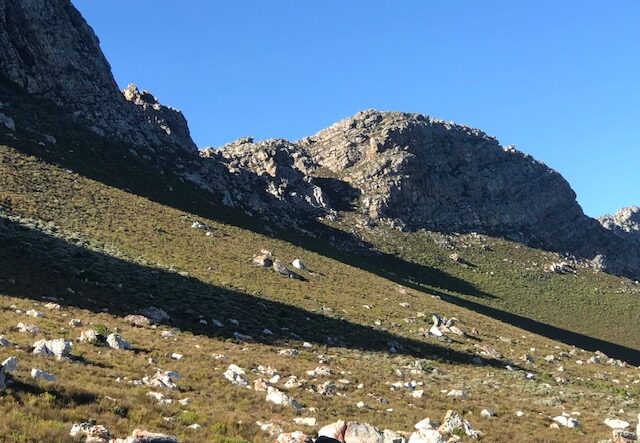
We looked up at the interconnecting hills (mountains?) that marked the eastern side. On this property twenty-nine (29) threatened species have been noted. These include the African Black Eagle, Cape Rockjumper, Ground Woodpecker, African Clawless Otter and Sentinel Rock-Thrush.
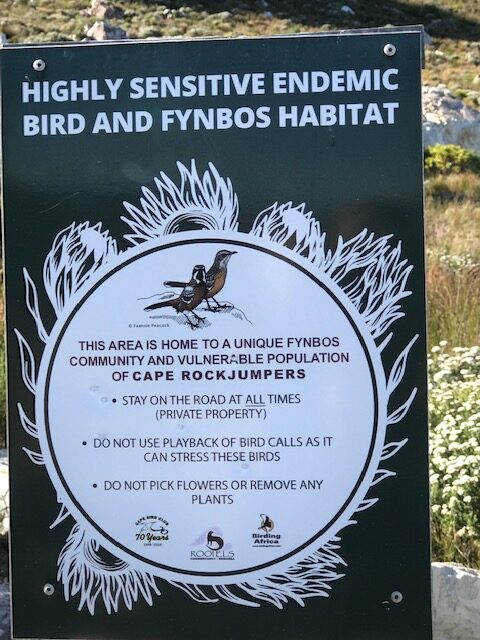
Above: A notice alerting visitors to the presence of Cape Rockjumpers
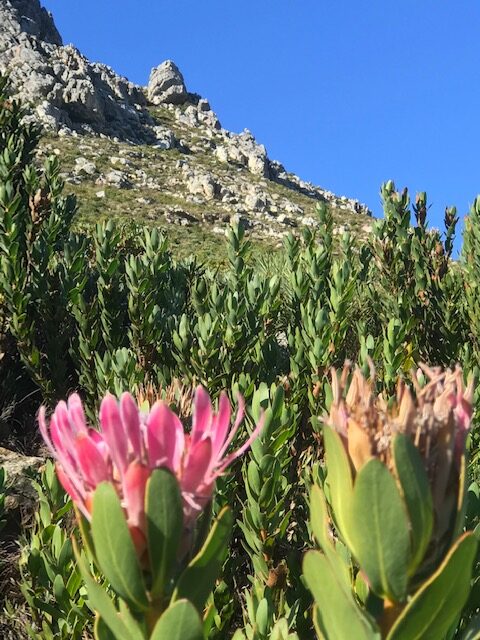
Above: The Protea compacta (a personal favourite) is classified as “Near threatened.”
We live in a world of I, me, mine. Our boundaries are literal as well as figurative. But in nature things move, need space … birds, seeds, animals. Eco-corridors serve, enable this movement.
And how to establish corridors across territory where 80% of the land is in the hands of private or communal ownership? This is where the topic touches on agriculture (farm land) – and stewardships. Landowners manage what happens on the farm, look after natural assets – and have the expertise and support of conservationists.
There are different levels of stewardships and you, the landowner, can work out which one is most appropriate for your operations. Included in the first option, Conservation area, are conservancies [see our page “Conservancies and farming.“] Your ownership of the property is never compromised, even if the higher categories call for greater commitment. We will touch on this more in a forthcoming page on our website.
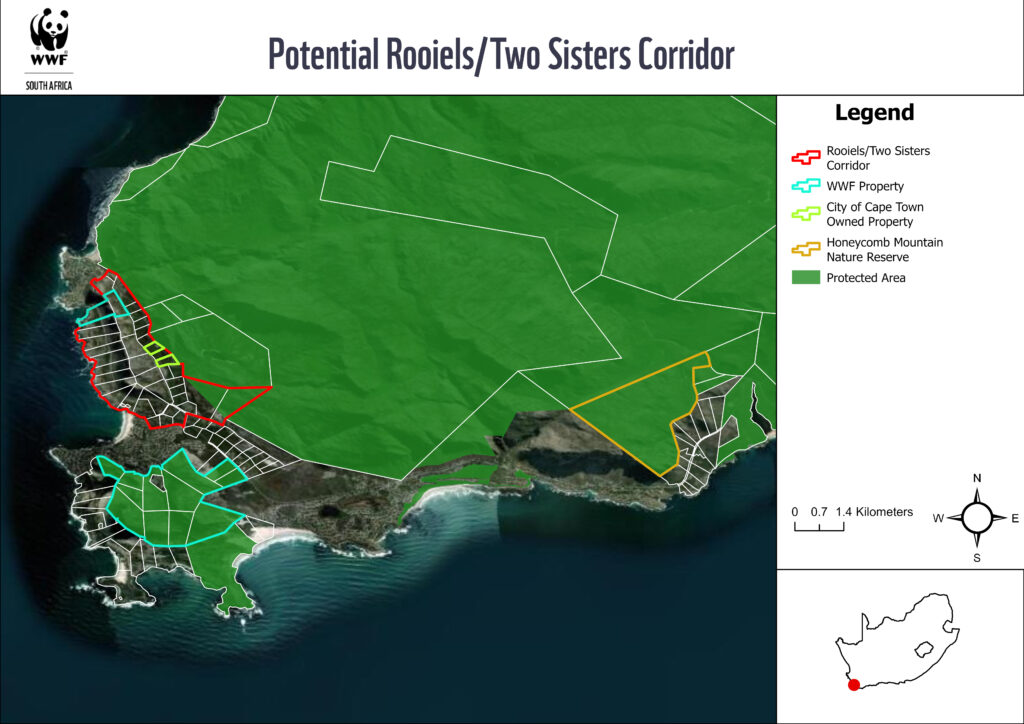
Above: Rooiels/Two Sisters Corridor (courtesy of WWF-SA).
The map above, included again for convenience’s sake, shows the patchwork of properties which make up the Rooiels Corridor (see red boundary line), most of which belong to private landowners. We would still hear talks later in the day from Jan Coetzee and Shaquille Benjamin (both WWF-SA and mentioned previously), and Ashley van Zuydam, owner of the Honeycomb Mountain Nature Reserve (see property enclosed by the yellow lines to the right of the map above).
The whole area is a Critical Biodiversity Area (CBA). The Rooiels Corridor plays its part by connecting the Kogelberg Nature Reserve Complex (KNRC) through a major National Freshwater Ecosystem Priority Area (NFEPA) wetland to the coast.
The Corridor connects catchment to coast “across a topographical range of 300m to sea level.” The hope exists that the corridor will expand, linking Rooiels town to Pringle Bay, and so include a Coastal Protection Zone.
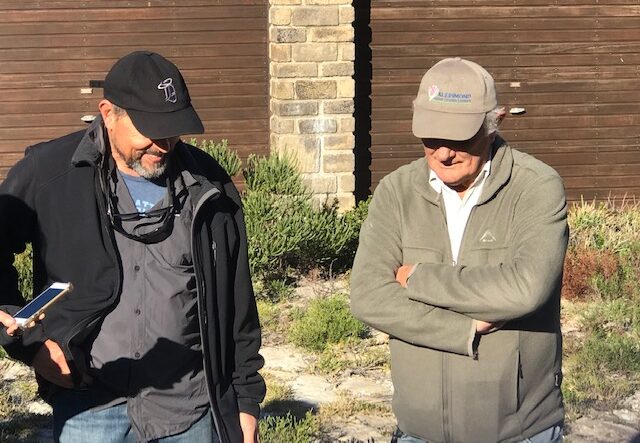
Above: Gildenhuys (ex-CapeNature) and Attwell (ex-Methodist minister)
We walked towards the coastline, down to the house which is situated just above rocks at the water’s edge, and were soon addressed on the corridor and the progress in securing the biodiversity of the Cape Floral Kingdom by Attwell, Gildenhuys, and the couple we mentioned in the previous post – Dine van Zyl and Graham McCleland, the two behind the website Rooiels Fynbos Flora and Fauna, https://www.rooielsfynbos.co.za/.
Below: Attwell addresses us.
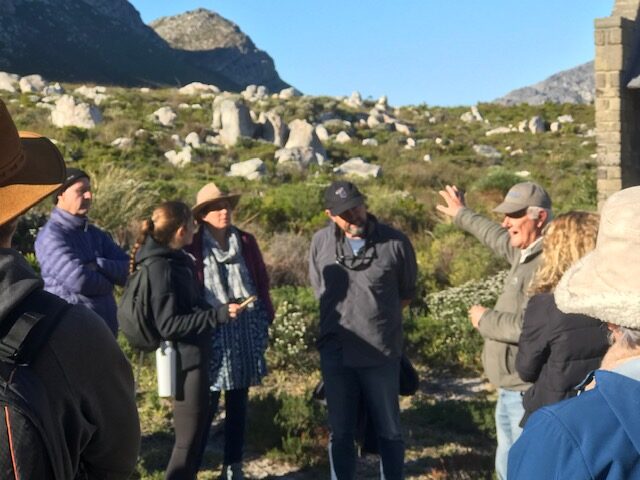
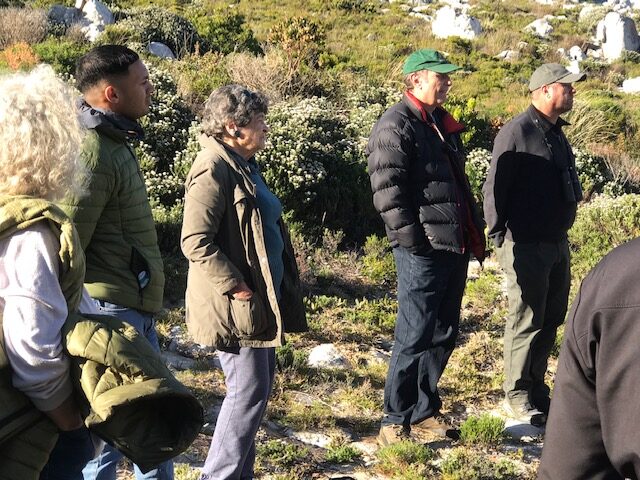
Above: listening, Weiss (left) and Benjamin (second from the left.)
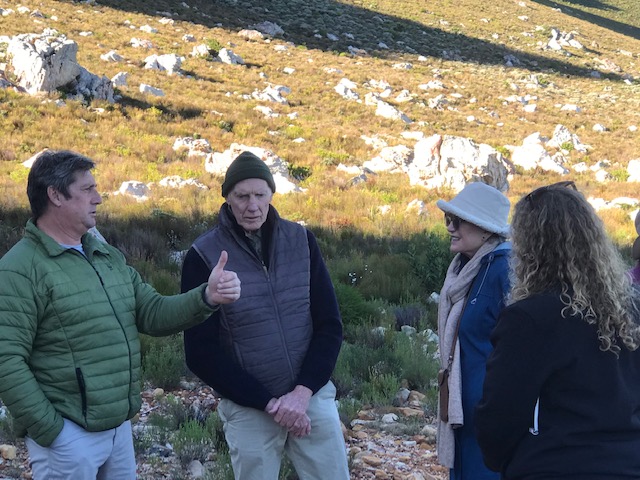
Above: Coetzee, McCleland and van Zyl
There were questions and answers, and we moved to the waterfront side of the house.
For now the financial priorities, according to Coetzee, are to keep the extension work going (namely to have a person like Benjamin available to assist landowners with stewardship applications), and to have incentive funding for landowners. But there is a dream to transform the house into a research or training centre one day if/when additional funding allowed it.
It was time for the last leg of the media trip: a tour of the off-grid Pringle Rock Distillery, last presentations on stewardships and a light lunch.