Written by PJ, from VELD FIRST, KAROO DIREK, DIE VEEPOS and KAROO-KALAHARI VEEVOER & LOGISTIEK
Auctions play a vital role in setting prices and price trends, primarily by way of their exposure and sensitivity to direct supply and demand volumes, volatility of this supply, and all associated costs.
In this paper I will discuss the three auction types currently most popular in the market, the risks and costs associated with each, and the suggested commissions to be paid to auctioneers. Livestock agent commission is the fee paid to a marketing, auction agents and/or auctioneers themselves for preparing, marketing, and managing the processes leading to the selling of the livestock.
Commission Structures and Factors
- Traditional Public Auctions: commissions are typically higher due to marketing, stockyard costs (carrying), compliance and feed costs, auctioneer overheads, and payment risks and insurances.
- Video and Real-time Auctions: commissions should be significantly lower due to the ‘virtual’ nature of both types. There are no ‘stockyard’ or ‘boma’ fees since the animals typically remain ‘on-the-farm’ or ‘in the feedlot’, and the principle operational costs for the auctioneer will be those associated to the electronic platform and model used. Exclusively digital or timed online listings often feature reduced commission rates, whereas webcast (real-time, streaming auctions), most often managed through and by traditional livestock agencies carry higher fees.
Additional Fees: There are always additional costs which should be taken into account, for example agent registration with APAC, insurance costs for buyers, sellers, auctioneers, with the current focus on bio-security, veterinarian fees must be accounted for. High transport costs will also play a more important role. Be aware of VAT exclusions and inclusions, and digital platform usage fees (these can be show-stoppers or game-changers).
Other key factors impacting commission rates:
- Distance from market and/or key input service providers.
- Access to, and road infrastructure
- Loading and off-loading infrastructure
- Terms and Conditions of the auction (the fine print, for example, time-frames for delivery, payment etc. post-auction)
- Public and legal liabilities and responsibilities including buyer/seller verifications
- Need for online security, verifications, insurance and/or back-up power supplies
- Sliding Scales: high-volume sellers or specific stud sales often negotiate custom percentages or fixed per-head fees.
Note: the rates for private sales should be highly negotiable, since these sales often involve part or whole, single-owner herds.
It is important to clearly differentiate between the three most popular types of auction currently used in the livestock market. These are:
1. Video Auctions
These are timed, digital-only and direct online auctions. The auctioned animals have been filmed previously on the farm and are then sold via video projection. Buyers bid remotely while the livestock stays on the farm, reducing transport stress, and many other costs. Market reach is a strong attraction of this model.
- Risks for buyer: HIGH – VERY HIGH
- Risks for seller: VERY LOW
- Risks for auctioneer: LOW
- Costs for buyer: can be VERY HIGH
- Costs for seller: VERY LOW (only opportunity cost)
- Costs for auctioneer: MEDIUM-LOW – primarily capital, limited operational, cataloguing and remote veterinarian
SUGGESTED COMMISSION RATES
- Small volumes: ~3%
- Medium volumes: ~2%
- High volumes: ~1%
2. Real-time Virtual Auctions
These are most often described as Streaming Online, Live Webcast or Internet Auctions, offered on digital platforms, and hosted in real-time. As with Video Auctions, this model is able to connect local sellers with a nationwide market of potential buyers.
- Risks for buyer: HIGH – VERY HIGH
- Risks for seller: VERY LOW
- Risks for auctioneer: LOW
- Costs for buyer: can be VERY HIGH
- Costs for seller: VERY LOW (only opportunity cost)
- Costs for auctioneer: MEDIUM-LOW – primarily capital, limited operational, marketing, cataloguing and remote veterinarian, real-time, online gearing can be a significant cost.
SUGGESTED COMMISSION RATES
- Small volumes: ~5%
- Medium volumes: ~3-4%
- High volumes: ~2%
3. Traditional Public Auctions
These are the old style, physical on-farm or sale-yard auctions, held on a fixed day and time at a physical location, the focus varies from mixed commercial animals of specific types, ages, or breeds of animals, to events dedicated to registered breeding animals with high genetic value.
- Risks for buyer: MEDIUM – LOW
- Risks for seller: MEDIUM-LOW
- Risks for auctioneer: MEDIUM-HIGH
- Costs for buyer: MEDIUM
- Costs for seller: MEDIUM – LOW (opportunity, management and transport costs)
- Costs for auctioneer: HIGH – VERY HIGH – significant operational (feed, yarding, transport), onsite security and veterinarian services, payment risks
SUGGESTED COMMISSION RATES
- Small volumes: ~6%
- Medium volumes: ~4-5%
- High volumes: ~3%
Contact PJ at 072 073 6805
***
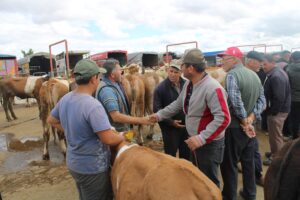
Photo: Halil İbrahim Özcan on Pexels
Relevant Agribook pages include “Livestock auctions.” The Business Listings below comes from that page.