Written by PJ, from VELD FIRST, KAROO DIREK, DIE VEEPOS and KAROO-KALAHARI VEEVOER & LOGISTIEK in August 2026.
Rapid loss of condition in your livestock could be due to biologically-induced anemia caused, for example by a high internal parasite load. However, equally possible a cause is plant-induced anemia, and at this time of year could very well be the more likely cause.
What is tannin?
Tannins are natural plant compounds, also referred to as tannoids and tannic acid, and were first identified by the French chemist Henri Braconnot in 1831. Tannin is a polyphenol, an organic chemical compound, produced by most plants as a means to defend themselves, acting as a pesticide against grazing, browsing and predation. The build-up of tannins can be dangerous to animals. Young plant leaves contain more tannin than mature leaves. Recent research shows that tannins assist in regulating plant growth. Note that tannin levels are lower in the warmest part of the day whilst increasing during the cooler evenings.
What is tannin toxicity?
Tannin toxicity, also called tannin poisoning, occurs when humans or animals ingest high amounts of plant material with high levels of tannins. These bitter compounds bind and precipitate proteins, disrupting digestion and potentially causing severe damage to the kidneys, liver, gastrointestinal tract, and even the reproductive organs.
Common causes of tannin toxicity?
- Drought and/or overgrazing: livestock and wildlife are forced to feed on high tannin containing plants, as preferred, more palatable vegetation is unavailable.
- Excessive intake: overconsumption of unrefined, high-tannin raw plant foods, for example silage and chop
- Species-specific vegetation: Ingesting large amounts of material from particular species of high-tannin producing plants for example certain Acacia, Eucalypt and Quercus species
What weather patterns trigger tannin toxicity?
- Prolonged drought combined with high temperatures and intense solar radiation triggers high tannin accumulation in plants, acting as a stress defense.
- Sudden cold snaps or frost events following warm spells also precipitate high secondary metabolite production, raising toxicity risks for grazing animals.
Virtually the entire South Africa has experienced these very weather patterns over the past three months.
How does the veldt indicate a potential risk?
Plants will indicate high tannin accumulation through distinct visual, structural, and chemical shifts that serve as survival mechanisms against severe weather or over-browsing. These include:
- Tissues turning brown or dark red: when plants undergo oxidative stress (like intense heat or cold), tannins oxidize and bind with cellular proteins. This manifests as structural browning, dark blotches, or a deep reddish-purple colour on leaves and stems.
- Tough, leathery foliage: high tannin accumulation changes the physical texture of leaves. Leaves become rigid, fibrous, and leathery to prevent water loss and deter insects.
- Stunted new growth: extreme tannin production channels energy away from standard cell division. This leads to dwarf leaves, shortened stem internodes, and compressed bud development.
- Wilting, browning, and dying of new growth: fresh shoots which might have sprouted during the warmer, moister period of the weather pattern will now wilt and eventually die off. The wilted, drooping shoots will contain relatively high of tannins.
How do wild animals and livestock indicate a potential risk?
- Animals will normally browse a plant, bush or patch of grass for only a few minutes before moving on due to rising bitterness.
- If local wildlife or livestock completely avoid a specific forage patch that they normally eat, it indicates a toxic spike in tannin levels.
Impact of tannin toxicity
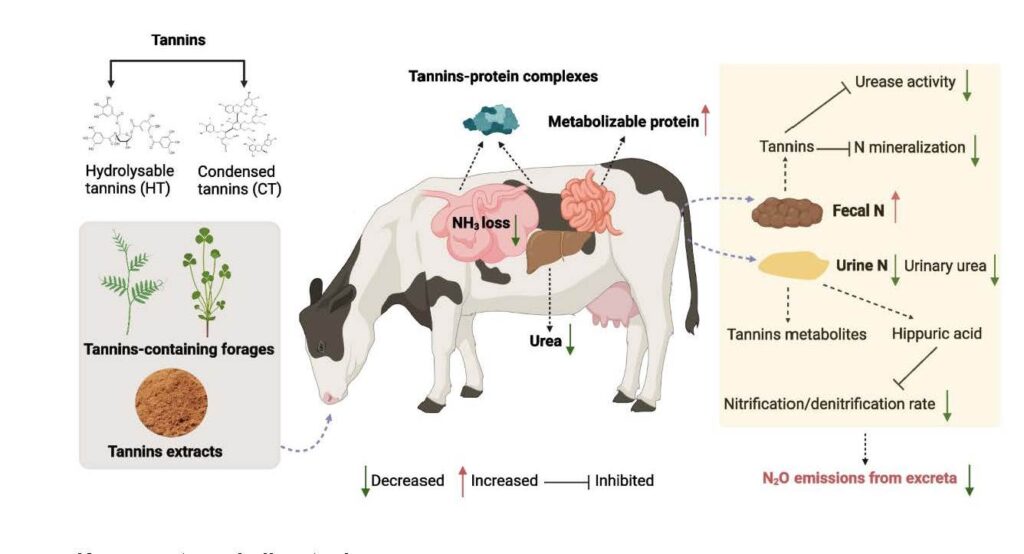
- In ruminants, the critical damage is to the rumen, caused when excessive tannins bind to proteins and erode the gut lining.
- Further, the rapid and sharp alteration to the gut chemistry results in a die-off of many species of healthy microbiota, and the proliferation on less-valuable, sometimes damage-causing organisms.
Key symptoms in livestock
- Loss of appetite and condition: all animals exposed to tannin toxicity and poisoning will exhibit loss of condition and vigour. Animals will refuse to eat (anorexia) combined with immediate rumen stasis, where the stomach stops churning food
- Gastrointestinal distress: severe stomach irritation, kicking at their bellies, grunting, bellowing, arching of backs, grinding of teeth, cramping, nausea and vomiting. Tannins cause severe ulceration and bleeding in the stomach and intestines, resulting in dark, foul-smelling, or blood-stained faeces, and/or bloody or dark diarrhoea.
- Organ damage: hydrolysable tannins can cause liver necrosis, kidney tubular necrosis, and general lethargy.
- Disruption to the rumen (essentially the animal starves with a full belly): in herbivores, nutrients are locked away by protein-binding, causing them to starve despite eating.
- Dehydration and weakness: rapid fluid loss combined with an inability to process nutrients leaves animals lethargic, weak, and depressed
- Frequent, strained urination: tannins break down into toxic metabolites (like gallic acid and pyrogallol) that attack the kidneys, leading to painful urination and eventual kidney failure.
- Disruption to reproductive cycles and fertility: high-level tannin poisoning in livestock disrupts reproduction by causing severe systemic toxicity, reduced nutrient absorption, and negative energy balance. This leads to low conception rates, weak oestrus, and late-term abortions due to liver and kidney failure.
Four key reproductive challenges are:
- anestrus: starvation of nutrients stops normal oestrus cycles.
- poor semen quality: nutrient and mineral deficiencies lower sperm count and quality
- embryonic loss: systemic illness causes early embryo death.
- abortions: severe maternal shock triggers late-term pregnancy loss.
Treatment
- Urgent and immediate ‘First Aid’: involves the moving of the livestock away from the toxic forage source followed by aggressive supportive care. This care is aimed at protecting the kidneys and repair of the gastrointestinal ulceration. Since there is no specific chemical antidote capable of reversing advanced organ damage, rapid intervention is critical
- Immediate neutralization and toxin binding using Polyethylene Glycol (PEG / Browse): if exposure is caught early or if animals are still browsing high-tannin plants, administer PEG, which is often sold commercially under trade names like Browse. PEG binds directly to free tannins in the digestive tract, neutralizing them and preventing them from damaging the gut lining or being absorbed into the bloodstream.
- Activated Charcoal: administer activated charcoal orally, immediately. It binds unabsorbed tannins and their toxic by-products (like gallic acid) in the stomach to prevent further systematic absorption.
- SEVERE CASES: Gastrointestinal relief, systematic care and veterinary oversight
- Important note: DO NOT attempt to encourage the animals to feed by presenting lucerne. This will in fact cause further damage due to the unavoidable introduction of further tannin, but also due to the fact of the damaged gastro-intestinal organs
Recovery
- Recovery from severe tannin poisoning in cattle takes several months and up to a year, though many severely affected animals may never fully recover economically since severe cases involve deep tissue damage.
- Mild or early-stage cases in cattle can resolve within a couple of weeks after removing the herd from the toxin source,
- Sheep have a smaller body mass and a fast metabolism, and their recovery timeline differs slightly from cattle
- Recovery from mild or early-stage tannin poisoning in sheep takes a couple of weeks if the flock is immediately moved away from the toxic source.
- However, for severe cases of poisoning, full physiological recovery takes several months and up to six months, assuming the animal survives the highly lethal initial phase
Contact PJ at 072 073 6805