Press release
South Africa has announced its proposed conservation targets which show that we are off course to achieve internationally agreed objectives of conserving 30% of land, waters and seas by 2030.
A draft copy of the third National Biodiversity Strategy and Action Plan (NBSAP) 2026–2035 made available during a national conference this week, shows that the current government conservation target is for 21% of South Africa’s land and freshwater and 20% of marine environments to be conserved by 2035. No-one could refer to these as ambitious targets by any measure.
One might understand such lack of ambition if the targets were viewed as conflicting with the interests of people who live on the land. However, only last year the South African conservation community, led by the Department of Forestry, Fisheries and the Environment and SANParks, with a wide range of actors from across state entities, business and civil society, developed an exciting vision including people, from traditional communities to private landowners in every step of the journey of future conservation expansion in South Africa.
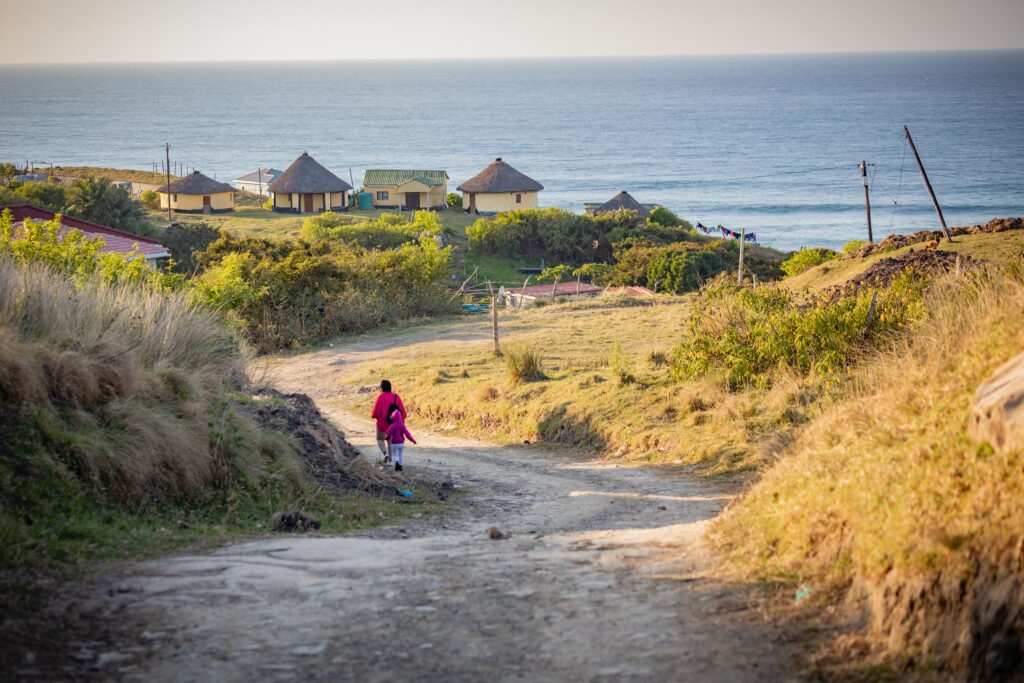
Above: Port St Johns scene. Photo used courtesy of WWF SA
Through such inclusive conservation there is the potential for millions of people to benefit from improved management of their land while pursuing compatible forms of land use and related businesses. This approach is founded on large-scale initiatives that deliver outcomes that are, at their roots, both nature-positive and improve the wellbeing of people who live on the lands in question. Some refer to these as mega living landscapes.
In WWF’s view these proposed numbers lack the required ambition to conserve both our unique biodiversity and unlock the finance to sustain and expand conservation efforts. The consequence is that we stand to lose the opportunity to focus the requisite attention and resources on improving the livelihoods of those who live on the land.
On the plus side, however, we note that the draft commits to ensuring that conservation areas are “effectively managed, equitably governed and integrated into broader ecological and social land, water and seascapes”.
In WWF’s view, focused collaboration around a more ambitious NBSAP conservation target would set us on the right trajectory for the next decade, building on South Africa’s 20-year track-record of successful biodiversity stewardship. It would also unlock substantial international finance to alleviate constrained national budgets. Countries that set bold, credible conservation targets are more likely to mobilise international biodiversity and climate finance.
Moving beyond this conference, it is critical to bring together national government, provincial government and conservation agencies, NGOs, private sector, and communities, to continue these discussions and come to an agreeable whole-of-society target that is ambitious and achievable, for people and nature. This target should incorporate secured, planned conservation and community development projects, and actively mobilise additional resources to achieve this ambition.
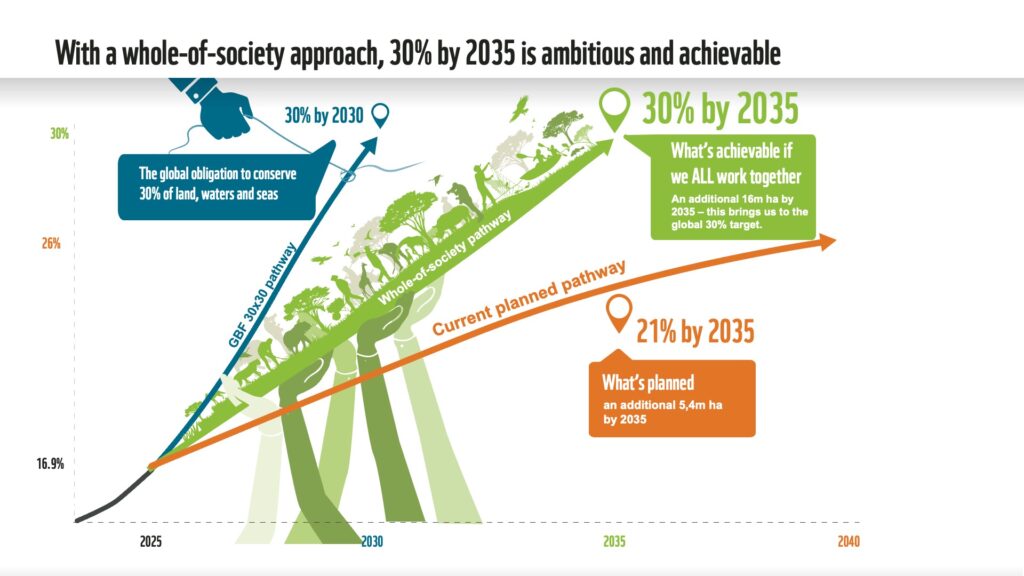
Above: National Biodiversity Strategy and Action Plan (NBSAP) Infographic used courtesy of WWF SA
More about the National Biodiversity Strategy and Action Plan (NBSAP)
The NBSAP is a requirement of signatories to the Kunming-Montreal Global Biodiversity Framework (KM-GBF) which was adopted by 196 countries at the 15th UN Biodiversity Conference (COP15) in December 2022.
The framework includes a commitment to conserve 30% of land, waters and seas by 2030 through inclusive long-term approaches whereby those living on the land remain stewards while becoming beneficiaries of improved livelihood opportunities derived from nature. Not only was South Africa a signatory to the KM-GBF, the G20 leadership summit in Johannesburg last year also reaffirmed this commitment.
At a country level, the NBSAP is a roadmap for how we intend to deliver on our commitment. An ambitious NBSAP has the potential to unlock socio-economic opportunities in our land- and seascapes while attracting international finance and investment to sustain and expand conservation efforts.
Relevant Agribook pages include “Biodiversity and ecosystem services” and “Conservancies and farming.” The Business Listings below come from these pages.