Written by Abrie Rautenbach, Managing Executive for Agriculture at Absa CIB
In August 1971, Richard Nixon went on American television and announced to the world that the United States would stop converting dollars into gold.
The decision marked the beginning of the end for the Bretton Woods era and sent currencies into a period of adjustment that was uncomfortable enough for richer economies and considerably less forgiving for developing ones, whose import bills could change dramatically through decisions made far beyond their borders. Two years later, amid another devaluation of the dollar and the upheaval surrounding the Arab-Israeli war, the oil-producing countries pushed crude prices sharply higher, with the export price index rocketing from 196 to 641. Oil had become vastly more expensive in the space of a year, and its reach through the economy meant that very little dependent on energy escaped untouched for long.
That had devastating consequences for agriculture in particular, as modern food production had become heavily reliant on fertiliser whose manufacture consumed enormous amounts of energy, while petroleum powered much of what came next, from the machinery working the land to the transport carrying crops away from it. Fertiliser prices tripled and, in some cases, quadrupled over the course of a year, adding heavily to the cost of producing food across the world.

Above: Abrie Rautenbach (photo supplied)
Many parallels can be drawn between then and now, as conflict and disrupted trade routes once again feed protectionist instincts, unsettle supply and work their way into the price of the fuel and fertiliser agriculture cannot do without.
One observation has become hard to shake from conversations across the continent: food security now ranks among the top three priorities in almost every market we encounter through our work at Absa. Much of that concern comes down to affordability, because inflation is pressing on the consumer at the same time as it is making food more expensive to produce, which leaves agriculture carrying pressure from both ends of the chain.
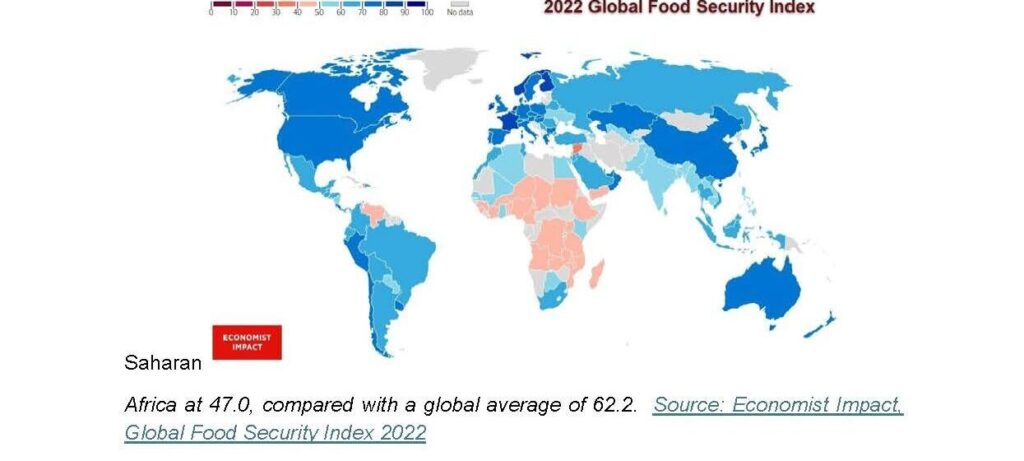
Above: The 2022 Global Food Security Index placed Sub-Africa at 47.0, compared with a global average of 62.2. Source: Economist Impact, Global Food Security Index 2022
Food security ultimately depends on whether the agricultural value chain can keep functioning all the way back to the producer. Across much of Africa, millions of small-scale farmers rely not only on rainfall and markets, but on access to the right technology, finance, inputs and information to remain productive. Drought-tolerant seed, precision equipment, irrigation sensors and digital platforms such as Khula can improve resilience, optimise input use, reduce the cost to serve producers and connect farmers to finance, certified inputs and reliable markets. Technology is therefore becoming more than an efficiency tool; it is part of the infrastructure required to build a more resilient and commercially sustainable food system.
The same logic has implications for how banks think about agricultural businesses, because value in the chain does not always appear where a conventional credit model expects to find it. Take a wheat miller that buys once a year and has to hold enough stock to keep operating for months thereafter. The grain in the silo can be worth more than fixed assets, which means a balance sheet viewed too narrowly can look oddly weighted even when the economics of the business are sound. Structured trade and commodity finance allows the bank to recognise that reality by taking a view on the stock, with the maize or wheat in storage supporting the funding required to carry it through the cycle.
A poor year does not give an agricultural business the luxury of stepping away from the next one, because production has to continue and capital has to go back into the system before the damage from the previous season has necessarily cleared, and that changes how the bank judges the business quite considerably. The first task is to understand whether the strain belongs to the business or to the wider industry, because an agricultural client caught in a difficult cycle needs to be managed very differently from one whose problems originate within the operation.
When the strain is sector-wide, the discipline required of the business is fairly straightforward: protect the balance sheet, avoid overcommitting to capital expenditure and preserve enough cash flow to buffer against the next disruption. This is something we have been helping clients with more and more frequently. We have also seen how much resilience can depend on the commercial relationships a business has built before supply comes under pressure.
During the fertiliser shortages that followed Russia’s invasion of Ukraine, there was a period when supply became uncertain enough for us to ask some of our large CIB clients how they were thinking about allocation. Suppliers told us that customers who had been buying from them for decades would be looked after first, because those relationships had been built over time. A client who returned every year with a competing quotation and little history beyond price did not carry the same weight when stock became scarce.
Agriculture has always had to live with uncertainty, but the frequency and reach of recent shocks have made the cost of being financially unprepared much harder to absorb.
What followed the turmoil of the 1970s was a concerted effort to keep agriculture functioning, much of it focused on making sure producers could still get what they needed to keep producing and could finance it when markets tightened. Fifty years later, the circumstances are different, but the underlying lesson is familiar: agriculture copes with shocks far better when the financial and commercial capacity to keep producing has already been built.
The next dilemma may come in the form of the El Niño, which is expected to intensify through the second half of 2026 and affect different parts of the continent in very different ways. For some agricultural markets that may mean drought; for others, excessive rainfall and flooding. Either way, this is a moment for agricultural businesses to speak to their banks about whether their current financial position gives them enough room to carry the next season, and what support may be available if it does not.