Press release
Farming in the Sandveld has always been about adapting. But as the region’s climate changes to a semi-desert, farmers will increasingly have to learn to farm alongside the plants, animals and people they depend on, says SW van Zyl of Sandveld Aartappels, the 2026 Syngenta National Potato Grower of the Year.
The Sandveld may be synonymous with potatoes today, but potato production in the region is relatively recent and was once very primitive.
“The Sandveld was originally a world of sweet potatoes, pumpkins, beans and small stock, particularly goats and some Afrikaner cattle,” Van Zyl recalls. “Potato farming only began in the late 1960s, and it was a primitive and slow process. Potatoes were planted by hand and dug up with a spade and fork. Grading was done in the field, using a board and a pick, after which the potatoes were put into 15 kg bags.
“The potatoes were not washed or brushed. They were simply a beautiful product when you lifted them straight out of our sandy soil. Initially, there was only King George, a very old potato variety, before new cultivars were introduced.
“Every Friday afternoon, my father-in-law, Koos Louw, would load all the potatoes harvested during the week onto the back of his Studebaker bakkie – up to 100 bags – and drive them to Sandberg station, where milk churns were also transported by train every day. Electricity only reached the Sandveld in 1981. Those were difficult times.”
Below: The Sandveld may be synonymous with potatoes today, but potato production in the region is relatively recent and was once very primitive.
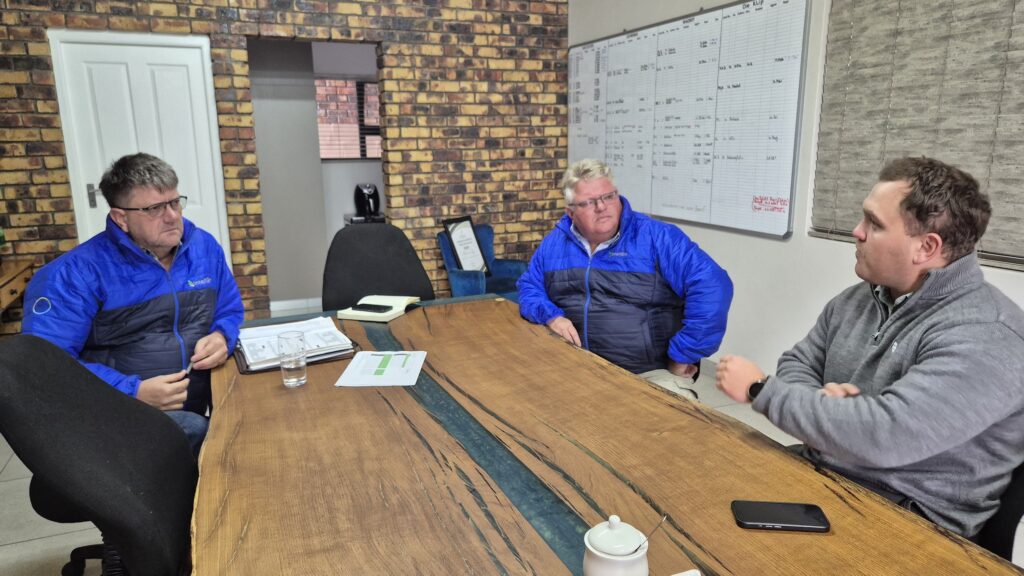
Above: The planning side of farming: From left, SW van Zyl of Sandveld Aartappels, the 2026 Syngenta National Potato Grower of the Year; Pieter Saaiman, Senior Crop Advisor at InteliGro; and Janco Cloete, InteliGro’s Area Manager for the Western Cape (Swartland & Sandveld).
It was while working alongside Louw that Van Zyl learnt to farm. He spent his first 10 years on 35 hectares and today plants 550 hectares.
“I grew into farming,” says Van Zyl. “That is the result of one-on-one training, learning in the field and getting your hands into the soil.”
With farm names such as Wadrift, Louwsrus and Vanzylsrus, determination, hard work and an enduring drive for success are all part of Van Zyl’s farming journey.
But the Sandveld in which he farms today is changing.
“As people, we will have to adapt alongside plants and animals, because the future will bring new challenges too,” he says. “Our indigenous vegetation has changed dramatically over the past 25 years, particularly as a result of lower rainfall. We used to have strips of indigenous bush so dense that you could not even drive through them in a bakkie. Today, we feel that the semi-desert is here.”
Van Zyl says changes in temperature have become increasingly pronounced over the past four to five years.
“Compared with the past 10 years, the veld and temperatures this year made it feel as though, at the beginning of August, we were already in the middle of October. Even the vegetation in August already looked like it does in October and November. My father-in-law, who is 78, says it is the first time he has seen this in the past 50 years.”
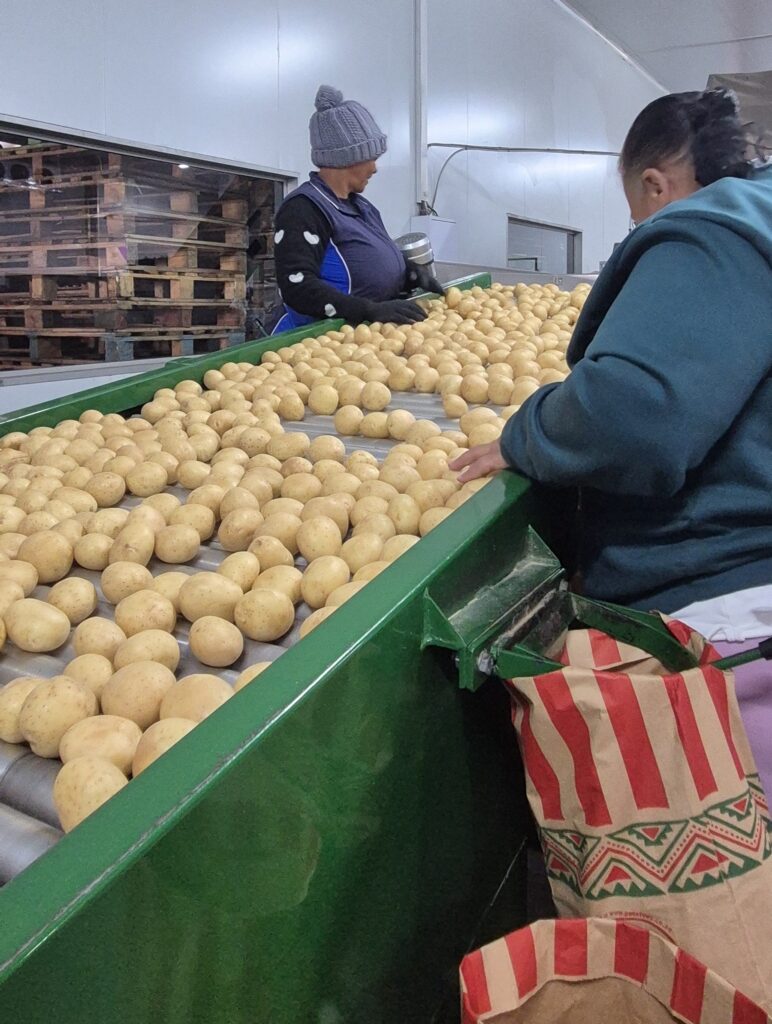
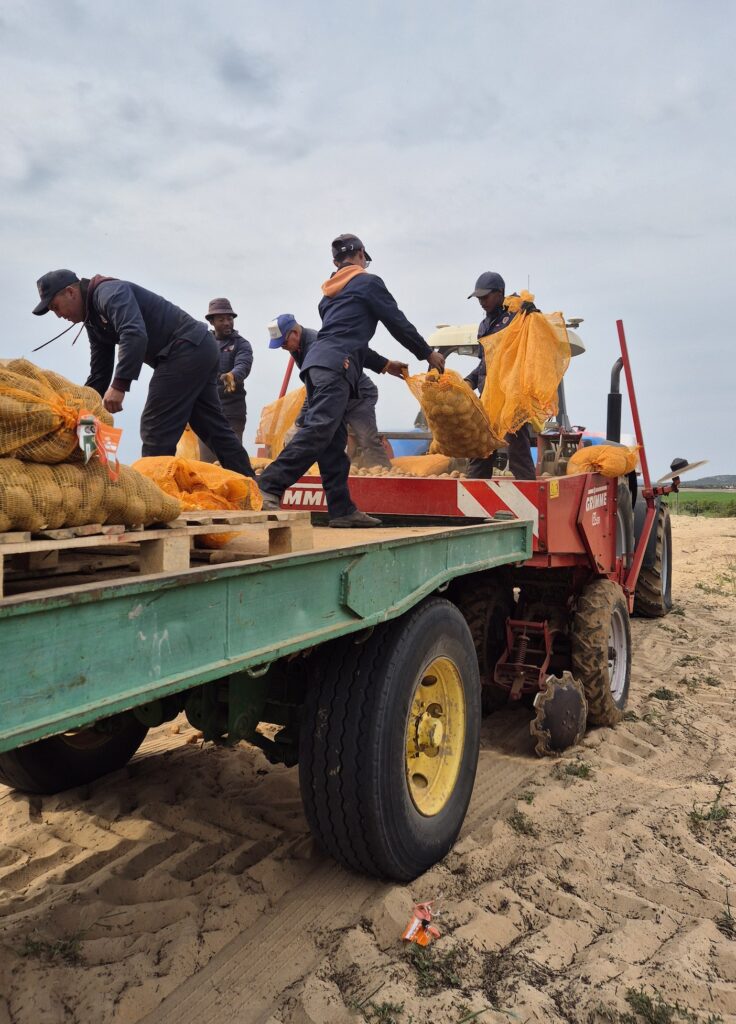
Above: Sandveld Aartappels employs hundreds of permanent workers, as well as hundreds more seasonal workers in its packhouses.
Adaptation becomes a daily exercise
Sandveld Aartappels produces potatoes throughout the year, primarily for the fresh market. The potatoes are washed, sorted and prepared in different pack sizes, from bulk packs to smaller consumer packs for retail.
“I believe this is where we make a difference – by adding value to our own product. For example, we supply smaller packs to the retail market to meet consumers’ changing needs.”
“Our input costs now, compared with the beginning of the year, are R100 000 higher purely as a result of increases in fuel prices,” says Van Zyl.
The Sandveld’s unique soil and climate make careful planning even more important. The soil is about 99% sand, while the wind can be both friend and foe.
“Inland, there are the winter farms, about 30 km from the coastal farms. Our coastal farms are where you can almost look out over the sea from the potato fields. These are our summer farms, where we farm about 6 km from the sea.
“That is why it is traditionally cooler here than, for example, in Clanwilliam, and why we can also harvest in summer, thanks to the wind that comes in from the sea, the Vaalwind. This cold south-westerly wind, which blows from August to March, can damage a potato plant when it is still young.”
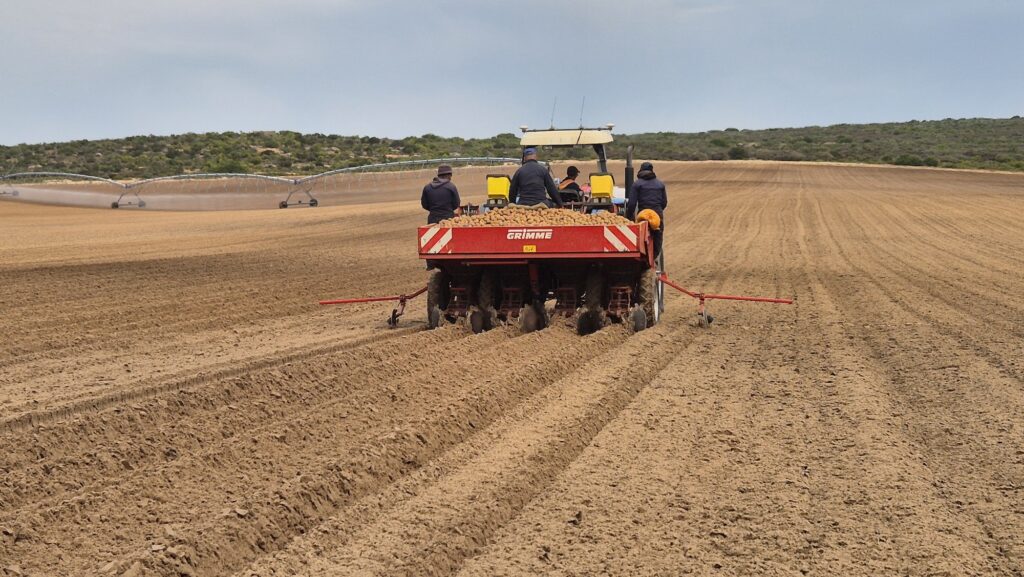
Above: The sustainability of potato production in the Sandveld affects the country’s food security, as the region is the only one with year-round production.
“We have three types of soil, with the structure of the sand particles differing from farm to farm. But even within a single 10-hectare centre pivot, you can have three to four different soil types,” says Van Zyl. “Some soils retain water and nutrients better. That is why we manually monitor our water use every day.”
Good-quality water remains the most important factor in sustaining the farming operation, says Van Zyl.
“We regard irrigation as a scientific challenge. We can work out exactly how many millimetres of water need to be applied at night to a particular segment of a centre pivot, and we can even take the following day’s temperature into account.”
Technology is also used to identify problems and potential disease hotspots quickly. Cover crops such as oats help protect the sandy soil, while hard-surfaced farm roads can reduce fuel consumption.
But technology is not the only answer. Sometimes, it is still the farmer who stands in front of a whiteboard through the night, working through cycles and calculations to make everything add up – and then calling in the experts for help.
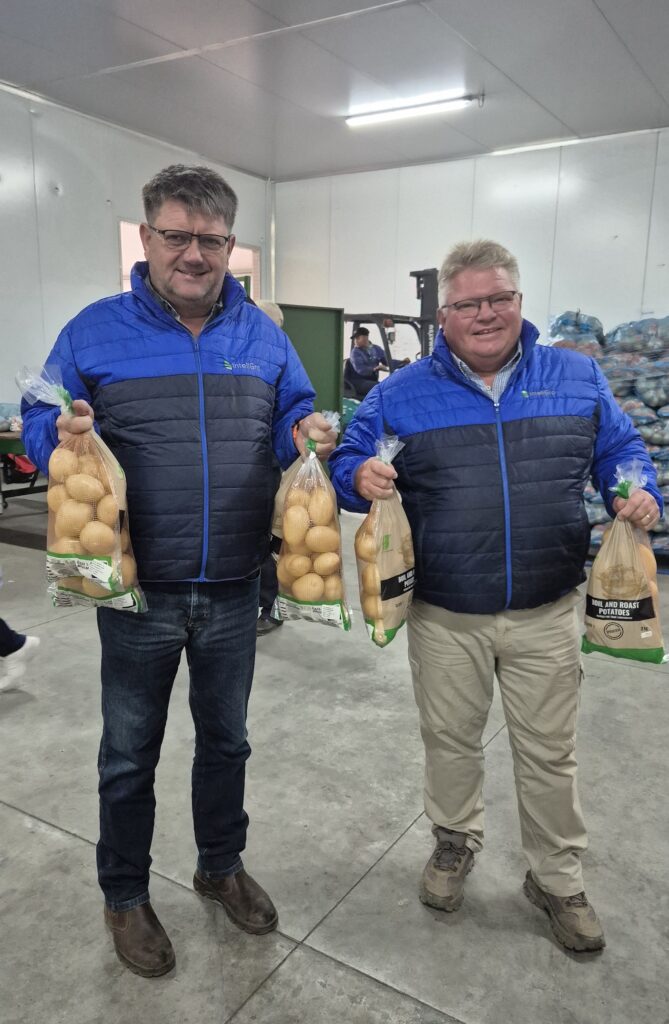
Above: SW van Zyl (left) of Sandveld Aartappels, the 2026 Syngenta National Potato Grower of the Year, with Pieter Saaiman (right), Senior Crop Advisor at InteliGro, who has been involved in potato farming in the Sandveld for three decades.
Farming together with the experts
Van Zyl acknowledges that an operation of this scale cannot be managed alone. He relies on his management team, long-standing employees and the experts who form part of the farm’s decision-making process.
Pieter Saaiman has been involved in potato farming in the Sandveld for about 30 years and is an experienced Senior Crop Advisor at InteliGro. As a native of the region, he knows the area and its challenges well.
“The world is very different from what it was 25 years ago. There is a ceiling. If you want to farm sustainably today, it requires a tremendous amount of planning, even a year ahead, because you have to have potatoes all the time. There are now only about four growers in the Sandveld who harvest throughout the year.”
Saaiman is in the field with Van Zyl every week, and sometimes every day, making decisions together about plant nutrition, fertilisation, water and weather conditions.
Saaiman uses weather stations, among other tools, to support his decision-making. Where possible, plant stress is addressed proactively, including with products that can help reduce the impact of heat stress on the plant.
Maximum residue limits (MRLs) are another important part of the conversation between advisor and grower.
“It involves constantly maintaining a fine balance between keeping the plant alive and meeting MRL requirements,” says Saaiman.
Saaiman says Van Zyl’s ability to plan ahead is one of his greatest strengths. “SW van Zyl is synonymous with planning. It is an honour to be part of SW’s growth journey and this well-deserved recognition of his hard work, dedication and passion for the industry.”
Their relationship extends beyond the technical aspects of farming. “We speak frankly to each other when it comes to business decisions, but I have also learned from him that balance, and particularly your family life, is important.”
For Van Zyl, this relationship is built on trust. “It is important to me to have partnerships because, for me, they serve as an extension of my business.”
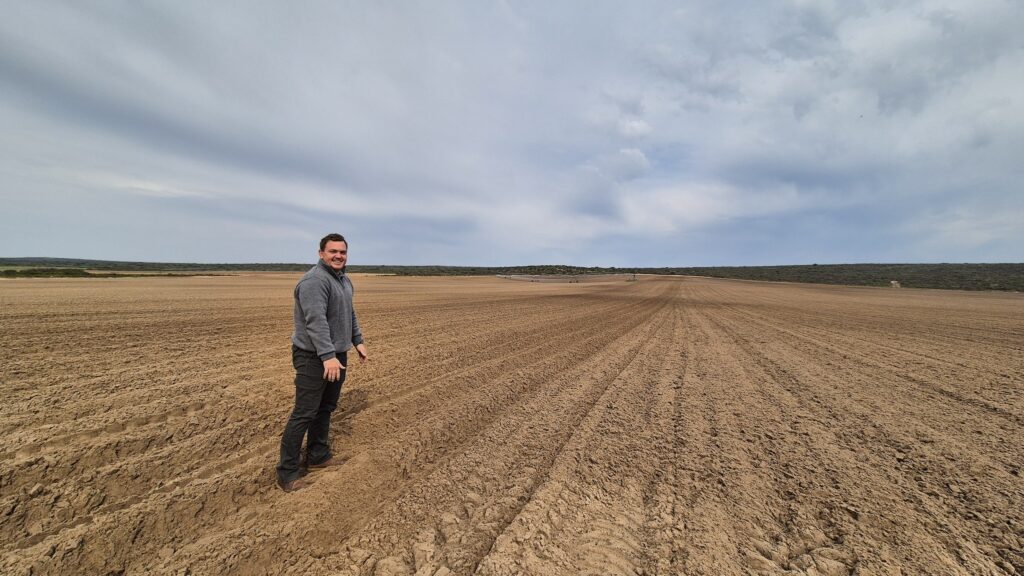
Above: Janco Cloete, InteliGro’s Area Manager for the Western Cape (Swartland & Sandveld), in a Sandveld potato field.
Janco Cloete, InteliGro’s Area Manager for the Western Cape (Swartland & Sandveld), has also worked with Van Zyl and Sandveld Crop Advisors for many years, including in a technical capacity.
Cloete describes Van Zyl’s willingness to collaborate as one of his defining characteristics. “He is always willing to test new technology and solutions in practice, such as the Potato Tuber Moth monitoring project, for the benefit of the broader industry.”
“It is essential to try out new solutions because pests such as the Tuta absoluta moth pose a very real threat to food security,” says Van Zyl.
The sustainability of potato production in the Sandveld affects the entire industry, as well as the country’s food security, as it is the only region with year-round production. Where there were once many growers, fewer than 15 large growers remain today.
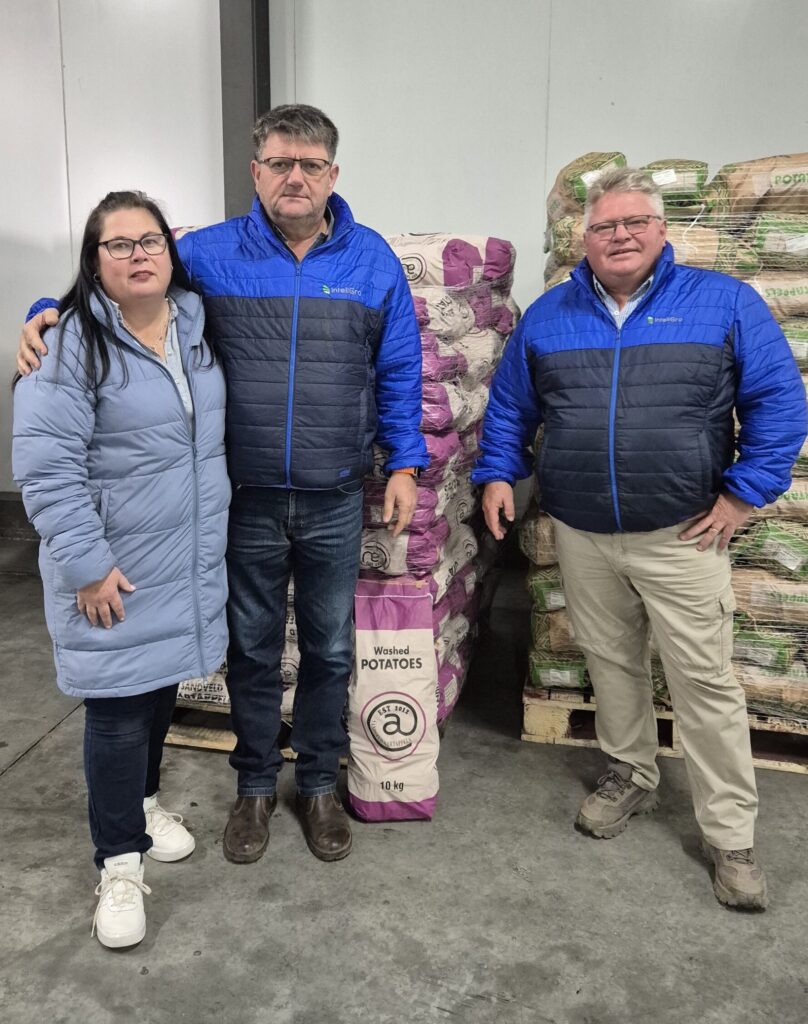
Above: SW van Zyl (centre) of Sandveld Aartappels, the 2026 Syngenta National Potato Grower of the Year, with his wife, Hannelie van Zyl (left), and Pieter Saaiman (right), Senior Crop Advisor at InteliGro.
Gratitude
For someone who embraces technology and precision, the people on the farm matter just as much.
Here, where Van Zyl is building a life with his wife, Hannelie, and their children, he employs hundreds of permanent workers, including managers and sorters, as well as hundreds more seasonal workers in the packhouses.
Van Zyl nevertheless remains humble. “Potatoes teach you to be humble. That is all I have been learning and doing my whole life.”
For Van Zyl, it ultimately comes down to moving forward with the right information and the right people around you – from performance statistics to input from market agents and the retail sector. He hopes that growers, crop experts and industry organisations will continue working together to explore and find solutions for the future.
In the packhouse at Louwsrus, his guiding principles for both farming and life remain prominently displayed on the wall: “The harder you work, the greater your chance of being lucky.” And: “Look ahead and be excited. Look back and be proud. Look up and be grateful.”
These are more than just slogans. These simple yet powerful words capture the mindset with which he approaches life, farming and the future.
Relevant Agribook pages include “Potatoes.” The Business Listings comes from that page.