We looked left, right as we crossed the road to climb back in the shuttle and soon the viewpoint had disappeared behind us and we were passing through Rooiels.
Rooiels … 75 kilometres from Cape Town on the eastern banks of False Bay.
You blink perhaps five times and you’ve passed through the village. So what’s the big deal?
The village is regarded as the entry point into the Kogelberg Biosphere Reserve (KBR) – the Biosphere designation coming from UNESCO in 1998 (the first in South Africa) – and also as the heart of the Cape Floral Kingdom.
You may admire the majesty and detail of these mountains that reach to the sun, the height and substance of them. You may be aware of the multi coloured textures of the vegetation as it passes you by. Whatever your impressions are, they will be deepened by a look at a website by husband and wife team (Graham McCleland and Dine van Zyl) that sets out the fauna and flora of this area.
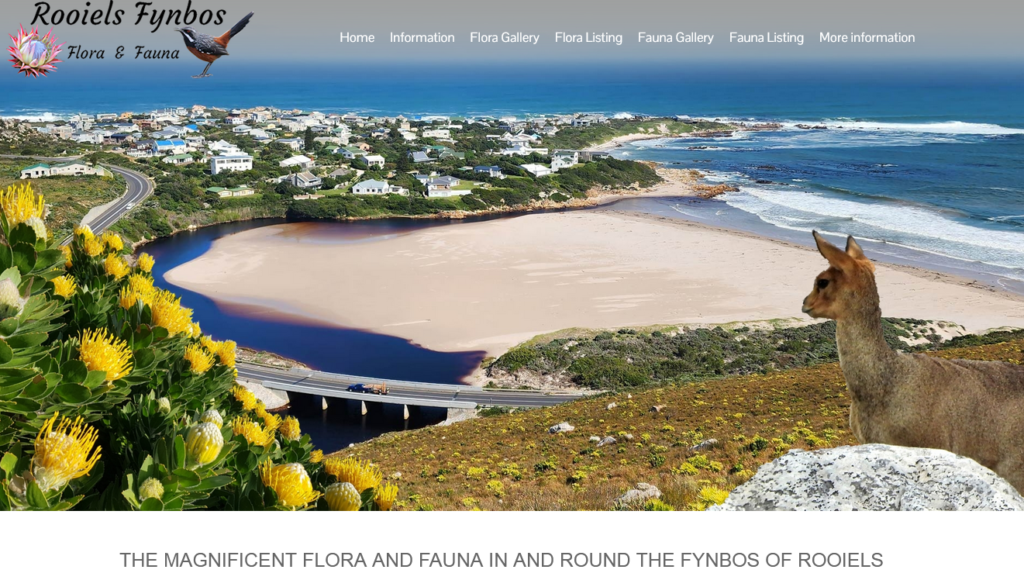
Above: A screenshot of https://www.rooielsfynbos.co.za, the website that provides a complete overview of the wealth of fuana and flora in the Rooiels Corridor
Also on the website is a copy of Rooiels Ecological Corridor: The Development of an Ecological Corridor from the Mountain Highlands to the Sea: An Ecological Overview, a paper prepared by Dr Alan Heydorn for WWF-SA back in 2019.
Victor Hugo famously said, “Nothing is more powerful than an idea whose time has come.” CapeNature might manage the core of the Kogelberg Biosphere Reserve, across the 3 000-hectare Kogelberg Nature Reserve and Stony Point Nature Reserve (see green on the map below); however, it is the surrounding Kogelberg buffer zone that has attracted attention. A read-through of an electronic handout given to the media on the Rooiels/Two Sisters Eco-Corridor shows the confluence of people and ideas after 2019, right up to the present day.
An original ten properties for sale outside Rooiels had been assessed by CapeNature and all found worthy of the highest level of Stewardship (Nature Reserve), and collectively so – they weren’t talking of them as stand-alone properties! A Rooiels Ecological Corridor was proposed and this was endorsed by CapeNature. The City of Cape Town (CoCT) was also looking to extend its Protected Area network. The concept of “Offset” would be explained later. (Where biodiversity was already lost, or where it was impractical to save, the City would procure land elsewhere to make up for this loss).
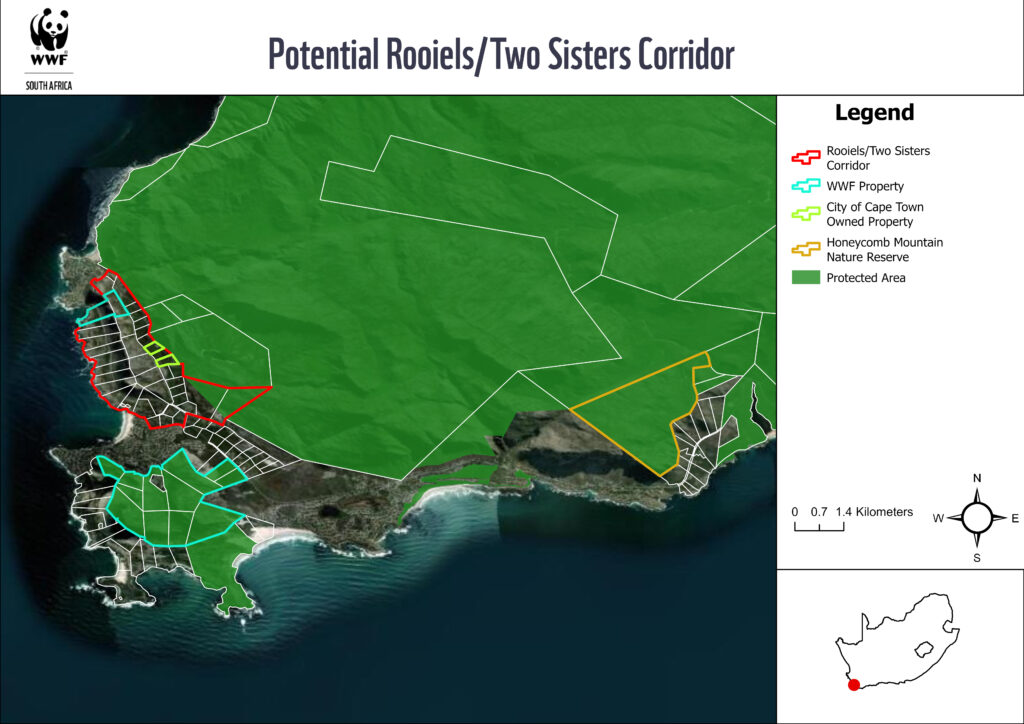
The picture above (used courtesy of WWF-SA) shows the Protected Area (green) and the Rooiels/Two Sisters Corridor (red line).
A “Two Sisters Conservancy” was pursued following a meeting in 2023 with landowners making up the extended Eco-Corridor, while the farm that we would be visiting that morning was one bequeathed to WWF-SA by Mike Harrison in the same year. Harrison’s was a timely, vital and much appreciated piece of the jigsaw puzzle evident on the left on the WWF-SA map above.
Shaquille Benjamin was appointed as a Fynbos Stewardship Officer with the express purpose of securing properties for conservation in the corridor and perhaps beyond it. In 2025, we are told, the emphasis began shifting from pursuing conservancies “to a more formal Stewardship model which could include City of Cape Town properties, WWF, and both Proactive and Reactive Stewardship options.” This continues in 2026 while the City of Cape Town carries on “investigating opportunistic property purchases within the corridor based on biodiversity value.”
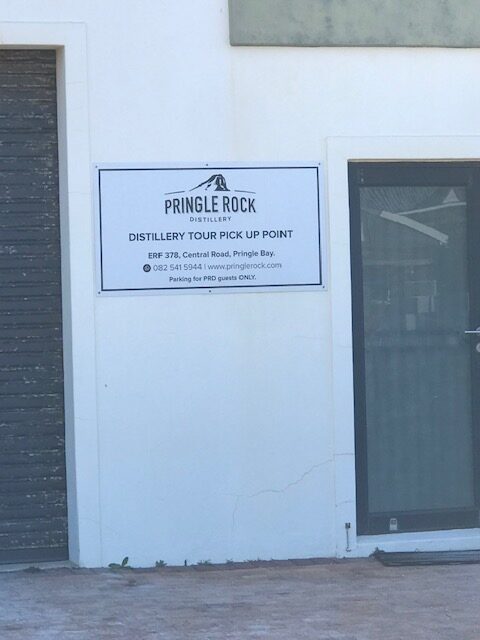
We arrived in Pringle Bay and came to a stop outside the Pringle Rock Distillery quarters where we dismounted for our transfer to the Pringle Rock Distillery shuttle.