Press release
Rural female farmers who once struggled to access formal markets are now supplying fresh produce to major South African retailers, schools and lodges following a successful training programme in Mpumalanga.
A women-focused business and skills initiative, convened by UVU Africa in partnership with Absa Bank, the African Development Bank and the Mpumalanga Green Cluster Agency, equipped 25 women farmers with the practical skills and confidence to integrate into the region’s agricultural supply chain.
The pilot programme, launched last year in Bushbuckridge, addressed key barriers to women’s participation in the agricultural economy, including limited access to training, market opportunities, technology, and financial management skills.
Explains Lara Rosmarin, Cluster Catalyst at UVU Africa, “The results have exceeded expectations. The initiative has created 66 new jobs through sustainable farming enterprises, with over 90% of graduates now supplying major retailers, agri-hubs, school feeding schemes, and local lodges. This programme demonstrates that with tailored training, mentorship and digital tools, rural women farmers can transform their operations and participate meaningfully in formal supply chains.”
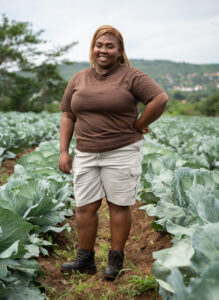
Above: Skhulile Phelitia Malibe from the Reya Shomisano Farm Project, in her field of cabbage.
Each farmer received comprehensive support, including agricultural training, business management skills and one-on-one mentorship, and each was given a tablet equipped with digital tools and data. Farmers can now digitally record and track farm operations, manage expenses, and access real-time weather forecasts.
The programme’s success is exemplified by graduate Smangele Makutu, who spent five years living on the streets before securing a 15-year agreement to farm on the grounds of her former high school. Her farm now supplies local supermarkets and supports agricultural education for current learners.
Key outcomes include 100% of participants reporting improved farm layouts and higher yields, 77% applying for funding or investment since completing the training, thanks to enhanced financial knowledge, and 92% diversifying their crops. Five regional farmer clusters have been established, enabling collaboration and collective market access across Mpumalanga.
Each farmer received guidance from a team of mentors, with a key focus on agriculture-specific enablement, entrepreneurship, and business skills. The programme combined workshops, one-on-one mentorship and on-field support.
Pilot programme to scale
Given the pilot’s success, UVU Africa plans to scale the initiative to farmers across additional locations in Mpumalanga, introducing further market linkages, financing opportunities and enhanced digital literacy programmes.
UVU Bio, part of the UVU Africa Group, will lead the next phase of this work. Building on the pilot project, modern farming technology will be introduced and the team will help farmers add more value to their crops. This means supporting farmers to process their produce into higher-value products, use crop waste productively, and create local hubs where they can collect, process, and develop new products together.
CEO of UVU Bio, Dheepak Maharajh, says: “Many farmers in this region have had to operate in a ‘survive, not thrive’ environment for generations, with limited access to technology, markets and beneficiation opportunities. This pilot shows that when the right support systems are in place, the path out of generational poverty becomes tangible and measurable.
“With the right collaborators and partners, this represents the next step in building an agricultural ecosystem that is more competitive, resilient and future-focused. One that opens genuine economic pathways for rural communities in Mpumalanga.”
Featured photo: UVU Africa graduation of 25 female farmers who have cracked Mpumalanga’s retail supply chain.